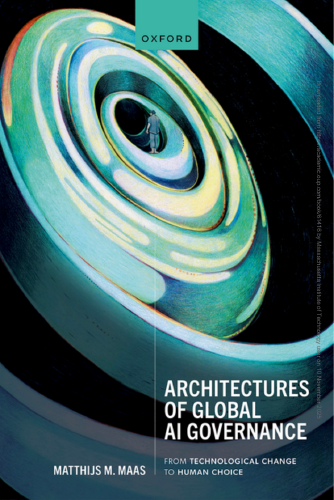
Maas is a Senior Research Fellow at the Institute for Law & AI and an associate fellow at Cambridge’s Leverhulme Centre for the Future of Intelligence. This 2025 Oxford University Press book (open access under CC BY-NC-ND) is the densest institutional-design treatment on this shelf. The subtitle does the thesis in seven words: From Technological Change to Human Choice. AI’s path is often narrated as an unstoppable wave. Maas treats governance architecture as something states and institutions can still choose, if they build for a moving target.
The contribution is conceptual more than algorithmic. He argues that global AI governance fails when it assumes a static technology, a stable legal toolkit, and a fixed political environment. Designers have to track three facets of change at once: sociotechnical change in what AI systems do to society; governance disruption, meaning AI altering the instruments of international law and administration themselves; and regime complexity, the crowded overlapping institutional landscape AI policy already inhabits. Soft law, unilateral state action, existing treaties, adapted international organizations, new bargains, and purpose-built institutions are evaluated as pathways with tradeoffs, not as slogans.
Chapter by chapter
Introduction: AI and Change
The introduction states the core problem in one question: how do you govern a changing technology, in a changing world, with tools the technology may itself alter? Maas surveys the spectrum of global AI challenges (from near-term misuse and concentration harms through longer-horizon advanced AI risks), recent initiatives across military AI, conventional AI policy, and post-2022 advanced AI forums, and the political hurdles that make cooperation hard even when stakes are shared.
He also introduces the book’s three facets of change and situates them in the emerging “advanced AI governance” literature. The methodological claim matters: without concepts for sociotechnical change, legal disruption, and regime complexity, proposals for “an IAEA for AI” stay at the level of analogy. The introduction is long because it has to load the vocabulary the later chapters use as tools.
1. The Stakes of AI: Progress, Trajectories, Impacts
Chapter 1 asks whether AI matters now and how much it may matter soon. Maas balances frontier progress claims against limits, bottlenecks, and failure modes. He treats AI as a high-variance technology: a portfolio of possible trajectories whose spread is itself a governance fact. Under uncertainty, waiting for certainty before designing institutions is a decision with distributional consequences.
He distinguishes two simultaneous stories that policy often conflates. One is frontier capability growth and the debates between hype and counterhype. The other is pervasive algorithmic proliferation already underway in ordinary administration, markets, and security practice. Governance agendas that only track the frontier miss the systems already reallocating power. The chapter ends on shared stakes across communities that usually talk past each other (safety, rights, development, security) and on the need to govern without pretending the forecast is sharp.
2. Scaling Law for AI: Issues, Necessity, and Feasibility
Despite the title’s nod to ML scaling laws, this chapter is about the political “scaling” of governance: which issues require global responses, why, and whether enforcement is remotely feasible. Maas maps problems along technical and political axes, then clusters them into focus areas so different risk communities can see overlaps without flattening everything into one master threat model.
The collective-action section is the hinge. Some AI-related goods and bads have the structure of global public goods or transnational externalities: compute supply chains, model proliferation, military competition, standard-setting power. National regulation alone will leak. Feasibility gets equal time. Barriers (sovereignty, verification, race dynamics, capacity gaps) are named without becoming an excuse for fatalism. Levers exist: chokepoints, clubs, standards, monitoring, nested agreements. The chapter’s conclusion is direct enough to be quotable in a briefing: the world needs global governance for AI, and “need” here is an institutional claim, not a vibe.
3. The Global AI Governance Architecture: Past and Futures
Chapter 3 is the historical and near-present map. Maas traces military AI governance tracks (roughly 2009–2025), conventional AI governance developments (2015–2025), and the post-2022 surge of summits, safety institutes, soft-law instruments, and advanced-AI initiatives. The point of the chronology is pattern recognition: what got institutionalized, what stayed aspirational, where forums proliferated without coherence.
Then he evaluates pathways forward as a menu: continue extending non-binding soft law; rely on unilateral state action; apply existing international law; adapt existing international institutions; negotiate new bilateral or multilateral agreements; establish new international institutions. Each pathway has failure modes (toothless norms, fragmentation, legitimacy gaps, capture, slow treaty processes). Readers looking for a single org chart will be disappointed on purpose. The chapter teaches tradeoff literacy before Part II reframes why static menus are not enough.
4. Sociotechnical Change: AI as Regulatory Rationale and Target
Part II begins by attacking the idea that “regulate the algorithm” is a complete description of the regulatory object. Maas taxonomizes common approaches (technology-centric, application-centric, value-centric, law-centric) and shows their limits when AI’s social effects arrive through new practices and institutional couplings, not only through a model file.
Sociotechnical change becomes both rationale and target: new artefacts, new behaviors, new distributions of capacity and vulnerability. The chapter asks why regulate (thresholds and affordances), when to regulate under uncertainty (anticipatory versus reactive traps), and how material features of AI systems create regulatory surfaces and “problem logics.” For lawyers and policy designers, this is the conceptual toolkit for writing rules that aim at social effects rather than freezing today’s technical stack into statute.
5. Governance Disruption: How AI Changes International Law
Chapter 5 flips the usual frame. Instead of only asking how law should constrain AI, Maas asks how AI systems disrupt the operation, interpretation, and enforcement of international law and global administration. He sketches a brief history of technology-law encounters, then offers a typology of disruption: governance development (gaps, ambiguity, mis-specified scope, obsolete assumptions, altered problem portfolios), governance displacement (automation of rule creation, monitoring, enforcement), and governance destruction (erosion or decline of architectures under persistent pressure).
This is one of the book’s most distinctive contributions. AI is not a passive object waiting for treaties. It can change what counts as monitoring, who can adjudicate, how fast norms evolve, and which legal categories still fit. Policymakers who ignore disruption will keep drafting for a legal world that the technology is already rearranging.
6. Regime Complexity: AI in a Changing Governance Architecture
Chapter 6 situates AI policy inside regime complexity theory: overlapping forums, soft and hard instruments, standards bodies, clubs, and competing normative agendas. Fragmentation, forum shopping, and inconsistent obligations are treated as design conditions, not temporary mess to be cleaned by one heroic institution.
Maas reviews critiques (dysfunction, inequality, incoherence) and defenses (flexibility, parallel problem-solving, resilience through redundancy). He then introduces a five-part analytical frame for reading a regime complex: origins, topology, evolution, consequences, and management strategies. That frame becomes the spine of Chapter 7. If you have ever wondered why AI governance feels like a conference circuit with conflicting communiqués, this chapter is the theory of that feeling.
7. Framing a Global AI Regime Complex in Five Steps
Part III turns the analytical frame into a method. Step through origins (purpose, foundations, design), topology (who is in the system, how dense and overlapping it is, where gaps and conflicts sit), evolution (political and technological drivers), consequences (including the centralization versus decentralization debate revisited with eyes open), and strategies for efficacy, resilience, and coherence.
This chapter is where the book becomes usable for practitioners. It will not spit out a single correct architecture. It will force explicit answers to questions that slogans skip: what sociotechnical changes are you targeting, which historical analogues actually fit, who must be at the table for legitimacy, how will the regime handle AI-driven legal disruption, and what happens when forums multiply faster than coordination mechanisms. For people writing white papers that currently end with “we need international cooperation,” this is the upgrade.
Conclusion: Choosing to Change AI
The conclusion returns to human choice. Adaptive architecture is available. Failing to update institutions is itself a decision with winners and losers. Maas’s closing emphasis is less techno-optimism than institutional agency: the intelligence era will still be politically authored, whether by design or by drift.
Read with Harding’s AI Needs You and you get complementary altitudes. Harding argues democratic publics should decide; Maas inventories the global plumbing those decisions must run through. Read with Russell and you get complementary control problems: uncertain objectives inside machines, uncertain and shifting architectures around them.
Where I’d push back
This is an academic monograph. It rewards slow reading and will frustrate anyone looking for a pamphlet. Labor power, workplace governance, and Southern data-worker politics appear more as stakes inside a global architecture problem than as organizing strategies with their own center of gravity. That is a scope choice, but it means the book pairs better with Hao and Benjamin than it replaces them. Also, any book published into a fast 2024–2025 governance landscape will age in the footnotes; the frameworks are built to survive that better than the case list will.
For people writing AI policy, working in international organizations or standards bodies, or trying to understand why “we need an IAEA for AI” is a slogan rather than a design, this is the serious reference text. It is free to read as open access, which removes the usual academic-tax excuse for not opening it.