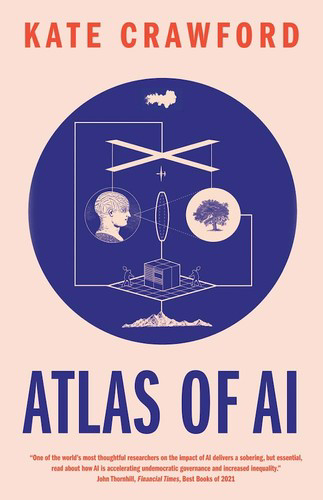
Crawford spent years inside Microsoft Research and co-founded the AI Now Institute, which is why this book never treats “AI ethics” as a sticky note on a product roadmap. She starts from a different claim: the systems we call artificial intelligence are built from planetary extraction. Lithium, rare earths, warehouse labor, scraped images, classification schemes, emotion labels, military contracts. The atlas metaphor is literal. She wants you to see the supply chain before you argue about the model.
The technical through-line is that machine learning systems are sociotechnical stacks. Training data is taken, labeled, and ordered by people with institutional power. Classification decides which categories the world gets to have. Affect recognition rests on contested psychology sold as solved sensing. Once you see those dependencies, a lot of industry language about “intelligence” starts looking like a marketing gloss over logistics.
Chapter by chapter
Introduction
Crawford opens with Clever Hans, the early-1900s horse that seemed to do arithmetic by tapping answers with his hoof. Investigators eventually showed Hans was reading tiny cues from the humans around him, not calculating. The story is a warning about mistaking a convincing performance for understanding. AI demos can look like intelligence while mostly reflecting the scaffolding around them: datasets, incentives, human feedback, staged evaluation conditions, and enormous compute.
From there she refuses the usual “mind in a machine” framing. AI, in this book, is earth, labor, data, classification, affect, and state power braided together. The introduction also stakes a methodological claim: you cannot evaluate these systems only by benchmark scores. You have to map the infrastructures and institutions that make the scores possible. That map is the atlas.
One. Earth
The first chapter follows the material base of computation. Crawford tracks mining for battery metals and other minerals that feed chips, servers, and devices, including contested extraction sites and the communities that absorb the environmental cost. Data centers show up as thirsty, power-hungry industrial plants, not vapor. Training and inference are billed as immaterial “cloud” activity while drawing down local energy grids and water.
She also ties planetary logistics to temporal control: synchronized clocks, logistics software, and the managerial demand to know what people and machines are doing at every moment. Google’s distributed systems and industrial timekeeping sit in a longer history of colonial and corporate efforts to coordinate labor across distance. The chapter’s governance implication is blunt. Climate and extraction are first-order AI facts. Any policy conversation that starts after the model is trained has already skipped the damage.
Two. Labor
Labor covers the human work that keeps “automation” running. Amazon warehouses are a central case: algorithmic management, productivity rates, injury risk, and the fiction that the system is primarily robotic. Mechanical Turk and related piecework markets appear as the other face of the same economy, where labeling, moderation, and microtasks are sold as flexible side hustles while functioning as essential infrastructure for machine learning.
Crawford’s point is not that robots will take all the jobs tomorrow. It is that AI systems redistribute work toward people with less bargaining power, often outside the firm that captures the product value. Time discipline, surveillance of workers, and the erasure of human contribution from product narratives all travel together. For labor organizers, this chapter is the bridge between warehouse floor conditions and the polished demo that investors see.
Three. Data
Data argues that “publicly available” became an industry permission slip. Personal photos, scraped web text, CCTV stills, and contested research datasets get folded into training corpora with thin consent regimes. ImageNet is the emblematic case: academic prestige and scale helped normalize harvesting and labeling practices that treated the internet as a commons for model builders, with limited regard for the people pictured or the social meaning of the labels.
Crawford connects dataset construction to extractive logics already established in Earth and Labor. Data is not found; it is taken and formatted. Once a dataset becomes a benchmark, its politics harden into infrastructure. Later fairness debates that treat the dataset as a fixed natural object miss how the collection process already chose winners and losers. This chapter reads differently after generative AI’s copyright fights, but the core claim still holds: consent and provenance were never optional extras.
Four. Classification
Before a model can learn, someone decides the taxonomy. Classification looks at that epistemic machinery: gender categories, occupational classes, racialized labels, risk bands, “safe” versus “unsafe” content. Drawing on science and technology studies (including Karin Knorr Cetina’s language of epistemic machinery), Crawford shows how labeling schemes encode a worldview and then get treated as ground truth.
The failed Amazon recruiting tool that downgraded resumes associated with women is one concrete example of what happens when historical hiring patterns become training signal. Bias here is not only a sampling error you can resample away. It is baked into the ontology: which differences are legible, which are collapsed, which are made into targets. For anyone building evaluation harnesses or content policies, this chapter is a reminder that the schema is already a political document.
Five. Affect
Affect critiques emotion recognition and the commercial stack built on Paul Ekman’s work and the Facial Action Coding System. The scientific claim under many products is that a small set of facial muscle movements maps cleanly onto universal inner states. That claim has been contested for decades in psychology. Industry deployed it anyway into hiring, education, border control, and workplace monitoring.
Crawford shows how training sets and posed images can launder a shaky theory into a product feature. The sales pitch is certainty about feelings from face and voice signals. The deployment pattern is asymmetric power: employers and states buy the tool; the scored person rarely gets a meaningful appeal. Even if human interviewers are biased, replacing them with an invalid instrument does not produce fairness. It produces laundered authority.
Six. State
State connects pattern recognition to surveillance and military power. Snowden-era infrastructure, metadata analysis, and the long entanglement of computing research with defense funding sit alongside more recent cases such as Project Maven and the Google employee revolt when consumer AI labor was redirected toward military computer vision. Crawford also tracks how that work can migrate to contractors when public employee resistance makes a project politically costly.
This chapter is less about speculative AGI risk and more about how states already use classification at scale. Cambridge Analytica appears as a bridge between commercial profiling and political targeting. The technical lesson for governance people is that “dual use” is not a future contingency. It is the default history of the field.
Conclusion. Power
The conclusion refuses to end on a list of ethical principles. Crawford reframes the atlas as a map of concentrated power: who extracts, who labels, who classifies, who deploys, who can refuse. “AI ethics” that never touches procurement, labor law, environmental regulation, or military contracting will keep missing the point of her map.
She asks readers to stop treating AI as an abstract intelligence problem and start treating it as an industry with material inputs and political outputs. The chapter is diagnostic rather than programmatic. That is a limitation and also the book’s honesty about its genre.
Coda. Space
The coda lands on tech billionaires’ private spaceflight and exit fantasies. After a book about mining Earth for compute, the dream of leaving a depleted planet reads like a punchline with a body count. It is short, sharp, and meant to make the extraction story harder to aestheticize as progress.
Some Caveats
The book is strongest as a materialist diagnosis and thinner as a program for what to build instead. Readers looking for concrete institutional designs, statutory language, or lab-level safety methods will need other books for that layer. It also predates the generative AI boom, so ChatGPT-era labor and copyright fights are foreshadowed more than documented. The frame still holds; the case studies need updating.
As an future data visualization project, I would like to create infographics for building out the Atlas of AI, with more current data on each of the inputs that Kate Crawford writes about in these chapters. I really enjoyed reading this book along with Empire of AI. Hao gives you investigative narrative about OpenAI’s particular post-colonial empire. Crawford locates the damage in the mines, contracts, and taxonomies that make the machine possible.
For anyone working on AI policy, labor, or infrastructure who still hears “the cloud” as a place without geography, this is the corrective. It will not teach you transformers. It will make it harder to talk about AI as if the hard parts were only mathematical.