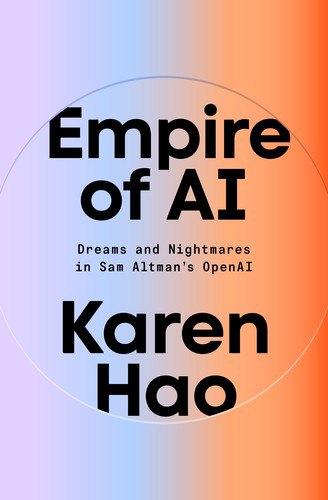
Hao covered OpenAI starting in 2019, two years before ChatGPT existed, which means this book is built on access most people writing about AI right now simply don’t have: something like 260 interviews, internal Slack logs, correspondence. The subtitle makes this sound like a Sam Altman book, and there’s plenty of that, but a huge amount of the real estate goes to people who never show up in the press releases.
The colonial framing in the title isn’t a loose metaphor. Data gets scraped off the entire English-language internet and treated as free raw material. Data centers draw down water and power in places like Chile, sometimes over the direct objections of the people who live there. Underneath all of it is a labor force in Kenya, Venezuela, the Philippines, Colombia, doing the content-labeling and moderation work that makes RLHF possible. They’re exposed to traumatic material and paid a few dollars a day, so the resulting product can be marketed to the rest of us as clean, safe, and almost magically capable. Hao spends real time on their specific stories instead of treating them as a statistic in a footnote.
The detail I keep thinking about: she documents workers getting fired for trying to unionize. That’s close to the center of the book’s argument. The mechanism that produces a friendly, “aligned” chatbot runs through a workforce with no protections and no leverage, selling into a market with a handful of buyers who can walk away from any contractor that lets its workers organize.
The Altman material is strong reporting: the board conflict, the 2023 ouster and reinstatement, his relationships with Sutskever and Musk. It also reads a bit more like a character study than some readers want from a book about an industry. One thing to know going in: Hao acknowledged after fact-checking that the book overstated a Chilean data center’s water usage by something like a factor of 1,000, a unit conversion error. It’s been fixed in later printings and doesn’t touch the labor reporting, which is separately sourced. Still a real error, and she owned it publicly.
Put this next to Human Compatible and you get a useful contrast. Russell’s whole frame is that alignment is a problem inside the model: get the objective function right and the rest follows. Hao barely engages with that at all. For her, the risk that matters already happened, to real people, mediated by labor contracts and corporate incentives, long before any model exhibited a single dangerous capability. Read them back to back and you start to see how much “AI safety” depends on where you decide to start looking.
For anyone doing labor organizing anywhere near tech, this is close to required reading. It’s mostly not about layoffs. It’s the fullest public account of who’s actually doing the underlying work and what happens the moment they try to organize. It’s also a good corrective to the idea that AI’s labor story starts with white-collar layoffs. The first people this industry ran over were data workers in the Global South, years before any of the current tech layoff headlines.