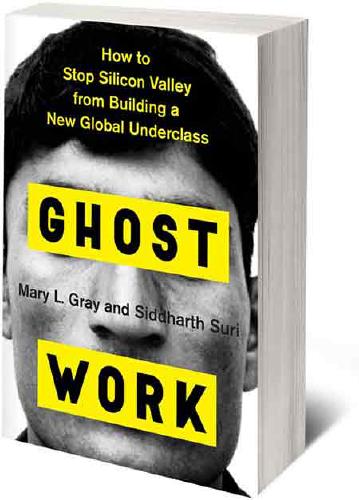
One of the most important books I’ve read all year.
In Ghost Work, anthropologist Mary L. Gray and computer scientist Siddharth Suri dismantle the prevailing narrative of automation, revealing the vast, largely invisible human workforce that makes artificial intelligence possible. What we call automation often involves the redistribution, fragmentation, and casualization of human labor rather than its elimination.
Drawing on research in the United States and India, the authors situate ghost work within a longer history of piecework and contingent labor, examining how algorithmic management exacerbates economic insecurity, erodes accountability, and shifts risk onto workers. Yet they also challenge the assumption that workers are motivated solely by economic necessity, exploring their desires for autonomy, flexibility, dignity, and community.
Perhaps most compelling is their examination of how workers build informal networks of collaboration and mutual aid despite working within systems that structurally isolate them. The book opens up important questions about platform cooperativism, collective ownership, portable benefits, and alternative models of labor organization.
I found this particularly relevant to our organizing at What We Will. How do we build worker power across a geographically dispersed workforce without a shared physical workplace, a common employer, or even a stable employment relationship? How do we transform informal networks of mutual aid into durable structures of collective power? And how do we build solidarity across professional hierarchies, employment classifications, and national borders?
As AI increasingly restructures knowledge work itself, these questions will become relevant to a much broader segment of the working population.
Essential reading for anyone interested in AI, the political economy of technology, and the future of the labor movement.