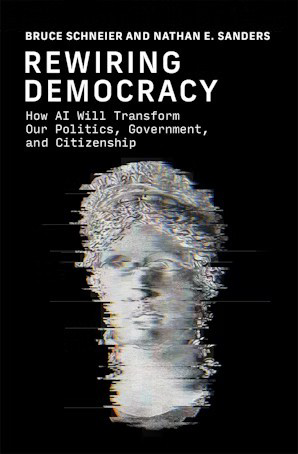
Schneier’s been writing about power and technology for three decades, mostly through a security lens: Data and Goliath, Click Here to Kill Everybody, A Hacker’s Mind. Sanders is a data scientist who’s done fellowships at the Massachusetts legislature and Harvard’s Berkman Klein Center. Neither of them is new to this. What makes the book worth attention is the scope: instead of picking one fight (deepfakes, or automated moderation, or AI in courts), they map AI’s effect across the entire machinery of democratic government at once. Legislatures, agencies, courts, campaigns, the civil service.
The core claim is that AI is a power-magnifying technology. It takes a single person’s intent and executes it with more speed and scale than any human ever could. That cuts both ways, which is the point of the book. A lobbyist using AI to draft denser, harder-to-scrutinize legislation is the same underlying capability as a legislator with two staffers using AI to actually read and respond to a bill they’d otherwise have to take on faith. Sanders has made the argument directly: AI could let Congress finally draft comprehensive privacy legislation instead of relying on industry-written model bills. Same tool, opposite outcome, depending entirely on who’s holding it and what constraints they’re operating under.
Their prescription is “Public AI”: models built by government, as a public good, under public oversight, rather than the current default where every civic AI application runs on infrastructure built by a handful of companies whose incentive is short-term profit. A few countries, Singapore and Switzerland among them, have already published fully open government-built models. Schneier and Sanders treat that as a live option, not a thought experiment.
Where the book gets criticized, and I think the criticism holds: it pulls its punches. A review on Schneier’s own site, written by someone else reading an advance copy, made the point directly: the authors are so determined to avoid sounding like “AI doomers” that they stay close to describing problems we’re already seeing rather than following their own framework to where it leads. They lay out early on that AI increases scale, scope, speed, and sophistication, then mostly stop short of asking what happens when agents are operating independently, at volume, for hours at a stretch, faster than any existing governance mechanism can respond. That’s not a hypothetical. It’s already the direction frontier labs are building toward. A book this granular about present-day AI-in-government examples has less to say than it should about the agentic near-future bearing down on the same institutions.
Read against Empire of AI, the contrast is useful. Hao’s book is about what AI companies are already doing to the people building the models. Schneier and Sanders are asking a different question: what happens once those models are inside the institutions meant to hold companies like that accountable. Put together, they cover a lot of the actual supply chain, from the data worker to the regulator, that most single-book treatments miss.
Recommend this to anyone doing policy work who wants a systems-level map of where AI is already changing how government functions, not just where it might someday. Go in knowing the authors are more optimistic about where this lands than the evidence in their own book fully supports.