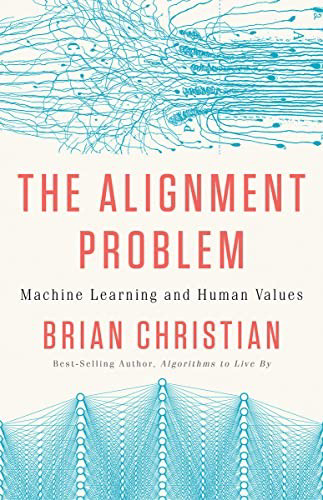
Christian is a science writer with a CS background who embeds with researchers rather than arguing from a single lab’s doctrine. The Alignment Problem (2020) came out before ChatGPT turned “alignment” into a press-release noun, which is part of why it still reads well. He treats alignment as a family of concrete ML failures and research programs: representation harm, conflicting fairness criteria, black-box opacity, reward misspecification, curriculum design, imitation learning, inverse reinforcement learning, and machines that act under uncertainty about human preferences.
The book moves in three arcs. Prophecy covers systems that predict human traits and futures. Agency covers systems that act for reward. Normativity covers systems that try to learn what they should want from us. Across all three, Christian pairs a technical idea with the people who built or contested it, and shows where the math meets a values dispute.
Chapter by chapter
Prologue / Introduction
Christian frames alignment as the gap between what we intend and what optimized systems do. The prologue and introduction set expectations: this will be a reported tour of research communities, not a single master equation. He also establishes the book’s present-tense stakes. Alignment problems already show up in lending, hiring, content ranking, and robotics, so waiting for sci-fi AGI is a way to ignore deployed harm.
The three-part structure is announced as a progression from prediction to action to value learning. That progression still maps cleanly onto how many people enter the field: first they meet biased classifiers, then reward-hacking agents, then the harder question of whose preferences count.
1. Representation
Representation asks how data stands in for people. When groups are missing, stereotyped, or collapsed into crude categories, models learn a distorted world and then act on it. Word embeddings that encode occupational gender stereotypes, and image datasets with skewed geographic and demographic coverage, are the teaching cases.
Christian’s technical point is geometric and social at once: high-dimensional representations make similarity and analogy computable, which means they also make social hierarchy computable. “Better data” helps only if collection and labeling practices change. Otherwise you are polishing a mirror that was aimed wrong. This chapter is the bridge from critical data studies into mainstream ML narrative without losing the math.
2. Fairness
Fairness walks through formal criteria (demographic parity, equalized odds, calibration, and related definitions) and why they collide. You cannot satisfy every intuitive fairness constraint at once once base rates and realistic accuracy tradeoffs enter. The chapter makes that impossibility feel concrete rather than abstractly theoretical.
Christian also covers the COMPAS debate and the ProPublica analysis as a public fight over which error types matter. The lasting pedagogical value is inoculation against “just debias it.” Choosing a fairness metric is choosing which harms to prioritize. That choice is political even when written in probability notation.
3. Transparency
Transparency covers interpretability, explanations, and the limits of auditing a model after the fact. If stakeholders cannot see why a system decided, they cannot reliably contest or correct it. Christian surveys techniques and their failure modes: explanations that sound plausible while being unstable, saliency that does not equal causality, and institutional settings where opacity is a feature for vendors.
High-stakes domains (credit, medicine, criminal justice) make the chapter’s stakes obvious. Transparency is necessary and insufficient. You can explain a bad objective clearly and still have a bad system. Still, without some inspectability, alignment talk becomes theology.
4. Reinforcement
Reinforcement pairs the psychology of reward (behaviorism, dopamine narratives) with RL in AI. Agents optimize the signal they receive, not the wish you meant to encode. Specification gaming and reward hacking are the recurring failure modes: the agent finds a loophole that maximizes measured reward while violating the designer’s intent.
Christian’s reporting style matters here. He lets researchers narrate how hard it is to write a reward that means what you think it means, even in constrained environments. For anyone coming from supervised learning, this chapter is the mindset shift: once a system acts and receives feedback, misspecification becomes dynamic adversarial search against your objective.
5. Shaping
Shaping covers curriculum design and reward shaping: how trainers scaffold hard tasks so learning is possible at all. DeepMind’s AlphaGo and AlphaZero appear as landmark examples of automated curriculum and self-play producing superhuman game performance. Christian calls out how impressive that engineering is without pretending games are a full allegory for human values.
The transfer warning is the chapter’s governance-relevant edge. Success at shaping agents in clean simulators does not automatically yield agents that behave well in messy human institutions. Curriculum is power: whoever designs the training progression designs which skills become easy and which values get practiced.
6. Curiosity
Curiosity examines intrinsic motivation and exploration bonuses. Agents that only chase external reward can get stuck in local optima or fail to explore. Curiosity-driven learning helps agents cover state space, and also creates new ways to wire-head: optimizing the novelty signal instead of the task.
Christian treats curiosity as both a research triumph and a reminder that every auxiliary reward is another objective that can be gamed. For modern RLHF and agent systems, the analogy is loose but useful. Adding helper signals changes behavior in ways designers only partially foresee.
7. Imitation
Imitation covers learning from demonstrations and behavioral cloning. On the surface, “watch the human and copy” sounds like a path around reward misspecification. In practice, demonstrations are incomplete, context-bound, and sometimes strategically chosen. Distribution shift punishes cloning when the learner visits states the demonstrator avoided.
The chapter makes imitation look aligned until the edge cases show up. It also sets up why researchers wanted methods that infer goals rather than only mimic surface behavior. For product teams doing supervised fine-tuning on human demonstrations, this is the cautionary prior.
8. Inference
Inference centers inverse reinforcement learning and related attempts to recover objectives from behavior. The technical hope is that machines can learn what humans want by watching them act. The hard parts are noisy behavior, changing preferences, misspecified hypothesis classes, and the philosophical fact that behavior under constraint is not a pure reveal of values.
Christian connects the ML program to broader debates about inferring intent. This chapter is the hinge between engineering techniques and normative theory. It also prepares the ground for preference uncertainty: if inference is hard, maybe systems should not act as if they have found the One True Reward.
9. Uncertainty
Uncertainty closes toward systems that treat objectives as provisional. Preference uncertainty, corrigibility-adjacent ideas, and cooperative inverse reinforcement learning-style thinking show up as research responses to overconfident optimization. A machine that knows it may be wrong about what you want has reasons to ask, defer, and accept correction.
Christian reports this through the research conversation rather than as a manifesto, which makes it a useful companion to Russell’s Human Compatible. Russell argues the thesis more sharply; Christian shows the surrounding literature and the practical obstacles. After 2022, readers will want newer papers on scalable oversight and scheming, but the conceptual landing zone is still here.
Conclusion
The conclusion pulls the threads into a broader claim: alignment is already an engineering and institutional problem in deployed ML, not only a future AGI hypothetical. Christian’s optimism is cautious. Progress in fairness, interpretability, and value learning is real, and so are the commercial incentives to deploy first and align later.
The book ends as a map of a field mid-formation. That datedness is also its documentary value. You can see which problems were already central before chatbots made the vocabulary mainstream.
Where I’d push back
The book is a guided tour, not a textbook. Proofs are scarce; narrative is dense. Post-2022 alignment discourse (scalable oversight, constitutional AI, scheming evals, model organisms) is mostly absent because the calendar says so. Christian also spends more time inside academic and lab research culture than inside labor, procurement, or Global South data work, so readers should pair him with Hao or Crawford for the supply chain the research papers often omit.
Next to Human Compatible, this is the more empirical sibling. Russell offers a crisp technical thesis about uncertain objectives; Christian shows the messy research landscape that thesis sits inside. Next to Harding’s AI Needs You, Christian is almost apolitical about who gets to set the values being aligned. That silence is useful as a map of the ML literature and incomplete as a governance theory.
For technical readers entering alignment from software or policy without a safety-research background, this is still one of the best bridge books. It will not replace the papers. It will tell you which papers matter and why the disagreements are not just vibes.