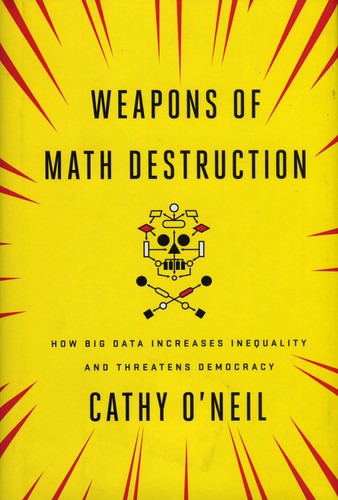
O’Neil has the resume that makes this book land: PhD in math, a tenure-track path abandoned for a quant job at D.E. Shaw, then a hard turn after the financial crisis toward warning people about the models she used to build. Weapons of Math Destruction (2016) popularized a useful diagnostic for bad scoring systems. A WMD, in her terms, is opaque, scales widely, and damages the people it scores, often while being marketed as objective.
The technical core is blunt and still under-taught outside fairness research. Models are opinions embedded in mathematics. Proxies stand in for what you actually care about. Feedback loops harden bad predictions into reality. When the people harmed have no way to contest the score, optimization becomes a political weapon with a spreadsheet UI.
Chapter by chapter
Introduction
O’Neil defines the WMD pattern and why big data’s promise of fairness often fails in practice. Institutions love scores because scores create actionable rankings at low marginal cost. Individuals experience those same scores as unexplained verdicts about their teachers, loans, shifts, or freedom. Efficiency for the institution can mean punishment for people who never see the rules.
She also sets expectations for the book’s method: domain tours rather than proofs. Each chapter follows a life-course surface (school, ads, justice, jobs, credit, insurance, civic life) where similar mathematical structures produce different human damage. The introduction’s job is to give you the pattern recognition so the cases rhyme.
1. Bomb Parts: What Is a Model?
This is the citizen’s guide to modeling. Inputs, proxies, training data, objective functions, and the difference between a model that is regularly updated against reality and one that is sealed against feedback from the people it harms. A baseball projection and a teacher value-added score are similar objects mathematically. They diverge ethically when one entertains fans and the other can end a career.
O’Neil stresses that choosing what to optimize is a values decision dressed as technique. If you cannot measure “good teaching” directly, you measure test-score movement and pretend the proxy is the thing. That move is the bomb part. Readers without a stats background leave this chapter able to ask better questions of any score that gates a life chance.
2. Shell Shocked: My Journey of Disillusionment
The personal arc from academic number theory through hedge-fund quant work into post-crisis skepticism. O’Neil describes the culture of finance models that were elegant, profitable, and disconnected from the wreckage they helped price. Her standing as critic depends on this chapter: she is not attacking math from outside the building.
The disillusionment also clarifies the book’s politics. She still loves mathematics. She distrusts the institutional incentives that reward opaque models when the downside is socialized. For technical readers, this chapter is useful as ethnography of quant culture as much as memoir.
3. Arms Race: Going to College
College rankings and admissions optimization as mutually destructive games. When U.S. News-style metrics become the scoreboard, schools chase the measurable inputs: selectivity, SAT averages, spending categories that read as quality. Students and families absorb tuition inflation and credential anxiety. The model rewards what is countable, not what education is for.
O’Neil also tracks how for-profit colleges and lead-generation advertising exploit the same data infrastructure, targeting vulnerable prospective students with predatory pitches. The arms race framing matters: once competitors optimize against a public metric, unilateral disarmament looks irrational even when the metric is socially destructive.
4. Propaganda Machine: Online Advertising
Targeted ads, data brokers, and microtargeting. The chapter links commercial surveillance to both petty predation (for-profit education leads, payday-adjacent offers) and political manipulation. Long before generative spam flooded the feed, O’Neil was describing an ad machine that finds people at moments of weakness and saturates them with optimized messages.
Technically, this is about feature-rich profiling and feedback on click/conversion objectives that ignore downstream harm. Governance-wise, it anticipates later fights over platform targeting, dark patterns, and electoral microtargeting. The WMD criteria fit uncomfortably well: opacity, scale, damage.
5. Civilian Casualties: Justice in the Age of Big Data
Policing and sentencing scores. Predictive policing tools trained on historically biased arrest data send more patrols to the same neighborhoods, generating more arrests that “validate” the model. Recidivism risk instruments used in pretrial or sentencing contexts can launder contested proxies into a number that looks like science in front of a judge.
This chapter is still one of the cleanest popular explanations of feedback loops in carceral AI. O’Neil’s emphasis on contestability matters: if defendants and communities cannot inspect or challenge the score, due process becomes theater around a black box. Read alongside Benjamin for the racial architecture; O’Neil supplies the quant’s account of how the loop closes.
6. Ineligible to Serve: Getting a Job
Hiring screens, personality tests, resume parsers, and automated filters. Employers buy efficiency; candidates experience silent rejection with no explanation and no appeal. O’Neil shows how instruments validated loosely (or validated on narrow populations) become hard gates for working-class applicants who need the job most.
The chapter’s labor implication is direct. Automated hiring does not merely “reduce bias” by removing a human. It relocates bias into features, cutoffs, and vendor secrecy, while weakening the candidate’s ability to negotiate or even know why they lost. Any organizer dealing with hiring discrimination in 2026 will recognize the shape.
7. Sweating Bullets: On the Job
Workplace scheduling algorithms and productivity scoring, especially in retail and logistics. Just-in-time shifts destroy stable childcare and sleep. Algorithmic management paces workers against targets that ignore human bodies. The model optimizes labor cost and customer demand curves; the worker becomes the residual.
O’Neil connects this to the broader WMD pattern: the people living under the model cannot see or rewrite its objective. For labor law and scheduling legislation fights, this chapter remains a clear narrative exhibit of what “optimization” looks like from below.
8. Collateral Damage: Landing Credit
Credit scores and their cousins in lending. Proxies and thin-file problems hit people already living close to the edge. Errors propagate; opacity blocks correction; e-scores and alternative data expand the surveillance surface under the banner of inclusion. Being scored as risky can make you riskier by raising your costs.
The chapter is careful about the legitimate underwriting need to estimate default risk, while insisting that secrecy plus proxy discrimination plus no meaningful redress is a political arrangement, not a law of nature. That distinction still matters in fintech marketing.
9. No Safe Zone: Getting Insurance
Risk pricing that blurs into social sorting. As insurers ingest finer behavioral and demographic data, solidarity pools shrink. People pay more for being statistically near a risky group, even when the causal story is weak. The “personalization” pitch hides a redistribution away from mutualization.
O’Neil’s warning is that insurance, once a mechanism for sharing risk, becomes another ranking engine when the data advantage grows unchecked. Policy readers will hear later debates about data-driven premiums and genetic or telematics sorting prefigured here.
10. The Targeted Citizen: Civic Life
Political microtargeting and civic manipulation. Democracy becomes another surface for WMD-style optimization: find the persuadable, suppress or inflame with tailored messages, measure engagement rather than public reason. The chapter extends the ad-machine logic into elections and public life.
Written before the full social-media-era reckoning, it still names the structural problem: civic speech governed by commercial targeting infrastructure will inherit that infrastructure’s opacity and incentive problems.
Conclusion
O’Neil calls for transparency, accountability, and regulation of high-stakes models. She wants algorithms that affect life chances to be open to audit, contestable by the scored, and constrained when they fail fairness or accuracy tests in deployment. The ending is closer to a civic manifesto than a technical standard.
That is both the book’s reach and its limit. It mobilizes readers; it does not hand legislators finished statutory language. Later fairness and AI governance literatures fill some of that gap. The conclusion’s lasting value is the insistence that WMD status is a choice about institutional design, not an inevitable side effect of math.
Where I’d push back
Published in 2016, this book cannot see transformers, foundation-model APIs, or RLHF supply chains. Some case studies have moved, and fairness research has gotten more formal since. Specialists may want more math and less parable. That was the point of the book, though: make the pattern obvious enough that non-quants could fight it.
Pair with Benjamin’s Race After Technology for the racial architecture underneath many of the same tools, and with Hao’s Empire of AI for how today’s “aligned” products still depend on opaque labor and scoring upstream. O’Neil remains the clearest popular map of how ordinary institutional ML already redistributes harm.
For engineers shipping ranking or risk models, and for organizers dealing with automated hiring, scheduling, or benefits systems, this is still the book I hand people first when they need vocabulary for what went wrong.